1900s
EARLY PREVENTIVE EXPERIMENTS showed that passive antibody administration could prevent active immunization, pointing the way to the later prevention of Rh immunization.3
1940s
DISCOVERY OF THE RH BLOOD GROUP SYSTEM and the identification of maternal Rh antibodies as the cause of erythroblastosis fetalis established the scientific foundation for understanding Rh hemolytic disease and developing preventive strategies.3
1960s
FDA approval and commercial introduction
Before the 1960s, there was no method available to prevent Rh immunization during Rh-incompatible pregnancies, which could result in hemolytic disease of the fetus and newborn (HDFN).1 At that time, HDFN affected 9%-10% of all pregnancies and contributed significantly to fetal deaths in the US.4
In the early 1960s, proof-of-concept experiments were conducted in Rh-negative men and demonstrated that anti-D antibodies could prevent Rh sensitization following exposure to Rh-positive red blood cells.3,5 The transition from volunteer studies to clinical trials in pregnant women marked a crucial milestone in RhoGAM development. In 1964, clinical trials with pregnant women began at Columbia-Presbyterian Medical Center under the direction of Vincent Freda, John Gorman, and William Pollack, leading to RhoGAM’s submission to the FDA.
RhoGAM received FDA approval for postpartum use in 1968, marking the beginning of widespread clinical implementation.6
Late 1960s-1970s
Expansion to antepartum prophylaxis
While postpartum administration of RhoGAM significantly reduced Rh sensitization, some women continued to develop antibodies during pregnancy.2,3 Evidence accumulated that small transplacental hemorrhages occurring throughout pregnancy could cause sensitization before delivery.2,7 This observation led to an investigation of antepartum prophylaxis protocols.3,8
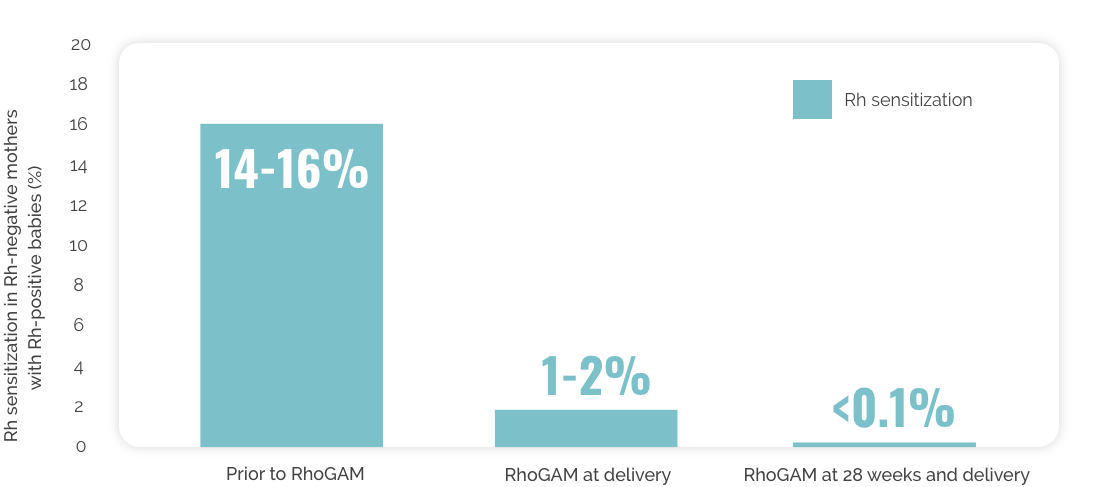
Clinical trials of antenatal RhoGAM prophylaxis began in Winnipeg, Manitoba in 1968.8 The addition of antepartum dosing at 28 weeks of gestation further reduced sensitization rates to 0.1%.9 The American College of Obstetricians and Gynecologists endorsed routine antepartum prophylaxis following these successful trials.1,2
Impact and current status
Since RhoGAM’s introduction in 1968, the incidence of Rh sensitization has decreased dramatically.2,3,9
Continuing legacy and future directions
RhoGAM is the first FDA-approved anti-D product that continues to protect millions of babies since 1968.5 It helped set the standards and the clinical practice guidelines that are still followed today.1,6
Rh immune globulin prophylaxis has dramatically reduced the incidence of Rh incompatibility–related HDFN by preventing Rh sensitization.2,6 From early investigations of passive antibody administration to widespread clinical use, RhoGAM became a major advance in preventive medicine.5